Conferences
We The Citizens runs one yearly political strategy conference for each party, on that party's own site, where citizens vote on who should speak instead of organizers deciding for them. The goal is an in-person conference every year; it starts as a big online event, with smaller online sessions along the way. This non-partisan site holds no conference of its own: it explains how they work and sends you to yours.
The conferences
| Your party's conference | How a conference works |
|---|---|
| • Republicans at WeCitizensR.com. The citizens' alternative to AmFest. | • How often we meet: in person once a year is the goal; online first, with sessions every few months. |
| • Democrats at WeCitizensD.com | • Citizens vote on the speakers: 1 to 5 thumbs up, or 1 to 5 thumbs down. |
| • Libertarians at WeCitizensL.com | • The speaker list is the test: judged on the record, the small star, and no money. |
| • Democratic Socialists at WeCitizensSocialism.com | • Why it lives on your party's site, not on this one. |
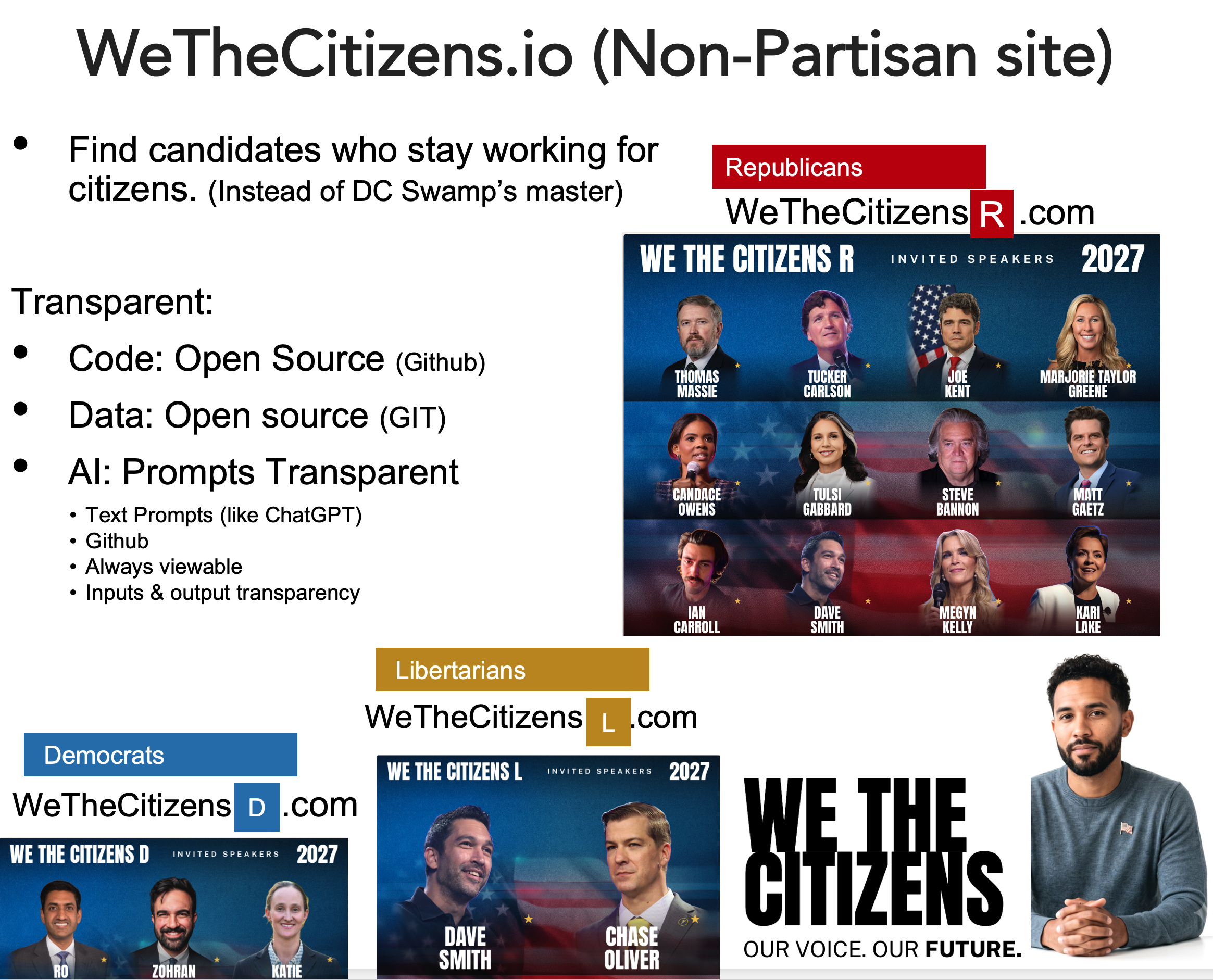
Three of the four party conferences, each on its own site. Everyone pictured has been invited and has not yet confirmed, which is what the small star beside each name means. The addresses are WeCitizensR.com, WeCitizensD.com, WeCitizensL.com and WeCitizensSocialism.com.
Watch the walkthrough
Six and a half minutes inside the app: the Republican conference's poster, a speaker's own page, how the awards are worked out from the record, and the other parties' conferences. The Republican conference is set beside AmFest for comparison.
Why this exists
Citizens no longer assume that the long-serving Washington figure works for them, and they are right to check. The same applies to the stage. When organizers hand out the microphone, the people on it are the people the organizers chose, and the voters in the audience had no say in it.
These conferences turn that around. The people who speak are meant to be intellectual and political leaders who represent citizens, and the citizens themselves say who that is. That includes the new political leaders the movement is helping into office. They get a chance to speak, and citizens get a chance to know them before they vote.
One conference per party, and none here
Each party's conference belongs to that party's community, runs on that party's own site, and is written in that community's own language. There is no movement-wide conference and no "all parties" conference.
| Party | Conference |
|---|---|
| Republicans | Yearly Conference on Political Right Strategy, at WeCitizensR.com |
| Democrats | The Yearly Strategic Conference, at WeCitizensD.com |
| Libertarians | Yearly Conference on Liberty Strategy, at WeCitizensL.com |
| Democratic Socialists | The Yearly Strategic Conference, at WeCitizensSocialism.com |
This site's job is the one in the table: point you at yours. It is the same rule the movement applies to everything partisan. See One App, Four Doors.
Citizens vote on the speakers
Every party's conference keeps a list of the people the movement is considering, and each one is put to the citizens by name: 1 to 5 thumbs up or 1 to 5 thumbs down, one vote per citizen, results open to everyone. What citizens said is published as exactly that, never as a judgment of the person. The details are on Citizens Vote on the Speakers.
The speaker list is the test
Every speaker is judged on the record, not the reputation: their Flamingo Award, how much we know about them, and any voting-record award. Anyone invited who has not agreed carries a small star, and no money moves through a conference. See The Speaker List Is the Test.
Once a year, and along the way
The goal is an in-person conference once a year for each party. It starts as one big online event a year, built around video. Between those, a party's site may hold smaller online sessions, possibly every three months, with thought leaders that AI helps find and that citizens then vote on like anyone else. See How Often We Meet.
Where to go next
- We The Citizens R, D, L and S: the four party front doors, each with its own conference.
- Meritocracy: how the movement finds the best candidates, and the standard a speaker is held to.
- Take Action: the area before this one.
- Karma: the area after this one.